

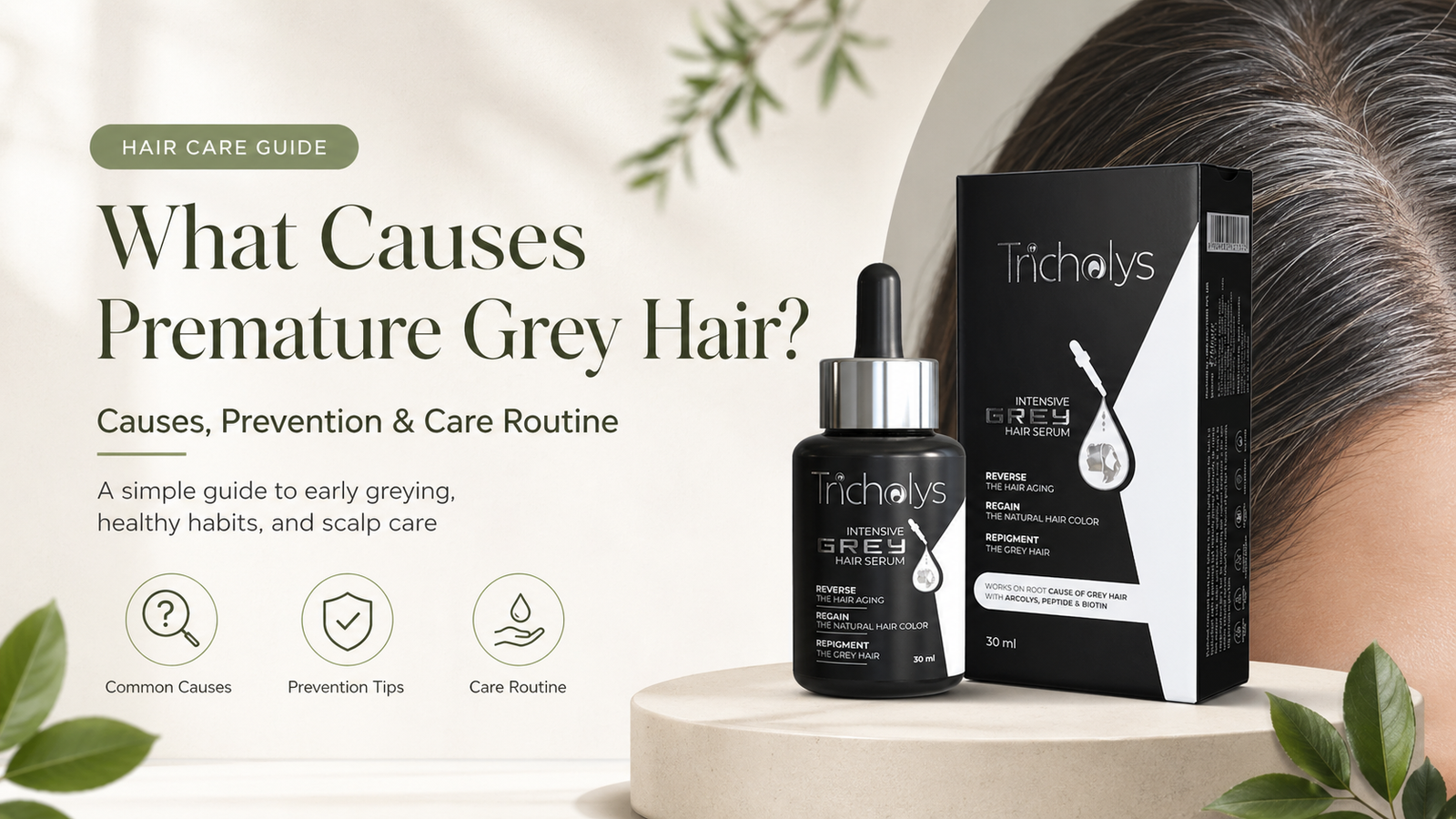

Premature grey hair can happen due to genetics, oxidative stress, nutritional deficiencies, stress, smoking, pollution, poor scalp health, or certain medical conditions. In many cases, early greying is influenced by more than one factor, so the right approach is to understand the cause and support hair health consistently.
Grey hair appears when hair follicles produce less melanin, the pigment that gives hair its natural colour. Premature greying does not always mean something is seriously wrong, but if it happens suddenly or rapidly, it is worth paying attention to your health, lifestyle, and scalp care.
What Is Premature Grey Hair?
Premature grey hair means hair starts turning grey earlier than expected. The exact age can vary based on genetics and ethnicity, but in general, greying at a younger age is usually called premature greying.
For Indian users, early grey hair is commonly noticed in the 20s or early 30s. Sometimes it starts with a few strands near the hairline, temples, beard area, or crown.
Premature greying can feel worrying, especially when it happens suddenly. The good news is that some contributing factors, like smoking, nutritional gaps, stress, scalp care, and harsh hair habits, can be improved.
Why Does Hair Turn Grey?
Hair gets its colour from melanin, which is produced by pigment cells called melanocytes in the hair follicle. As melanin production reduces, the hair strand gradually loses colour and appears grey, silver, or white.
Ageing is the most common reason for grey hair, but premature greying may be linked to stress, diet, smoking, autoimmune disease, and other factors. Cleveland Clinic notes that age is the most likely cause of typical greying, while premature greying may be associated with stress, diet, smoking, or autoimmune conditions.
In simple words: grey hair happens when the pigment system inside the hair follicle slows down.
Common Premature Grey Hair Causes
1. Genetics
Genetics is one of the strongest causes of premature grey hair. If your parents or close family members had early greying, you may be more likely to experience it too.
This type of greying is not always fully preventable. However, good scalp care, nutrition, and healthy habits may still support overall hair quality.
2. Oxidative Stress
Oxidative stress happens when free radicals and internal stressors damage cells faster than the body can manage. Hair follicles are also affected by oxidative stress.
Scientific reviews on premature hair greying describe oxidative stress, genetics, lifestyle factors, and follicle-level changes as important contributors to early greying.
For Indian users, oxidative stress may be influenced by pollution, smoking, poor diet, stress, poor sleep, and UV exposure.
3. Vitamin and Mineral Deficiencies
Nutritional gaps may contribute to premature greying in some people. Vitamin B12 deficiency is often discussed in relation to premature hair greying, although the mechanism is not fully understood. A review on premature graying notes that vitamin B12 deficiency can be associated with premature graying.
Nutrients commonly discussed in hair health include:
- Vitamin B12
- Iron
- Copper
- Folate
- Zinc
- Protein
- Vitamin D
This does not mean everyone with grey hair needs supplements. It means that if greying is sudden, early, or accompanied by fatigue, hair fall, weakness, or other symptoms, it may be useful to consult a doctor and check for deficiencies.
4. Stress
Stress is commonly linked to early greying, although the relationship can vary from person to person. Chronic stress may contribute to oxidative stress and affect hair follicle health.
Cleveland Clinic notes that stress has been scientifically shown to accelerate the greying process, though reducing stress may not reverse grey hair for everyone.
Stress management may not be a “grey hair cure,” but it can support overall hair, skin, sleep, and health.
5. Smoking
Smoking is one of the most avoidable lifestyle factors linked with premature greying. Smoking increases oxidative stress and may affect the pigment-producing cells in hair follicles.
A dermatology review describes smoking as a known external source of free radical generation and oxidative stress that may contribute to premature ageing changes in hair follicles.
If you are dealing with premature grey hair, reducing or quitting smoking is one of the most practical lifestyle steps you can take.
6. Pollution and UV Exposure
Pollution, dust, heat, and sun exposure can contribute to oxidative stress. In Indian cities, daily exposure to traffic pollution, sweat, hard water, and outdoor heat may affect scalp and hair health.
This does not mean pollution alone causes grey hair in everyone, but it may contribute to stress on the hair and scalp, especially when combined with poor hair care and lifestyle factors.
7. Poor Scalp Health
A healthy scalp supports better hair growth and hair quality. If the scalp is oily, flaky, itchy, inflamed, or irritated, it may affect the overall hair environment.
Scalp issues do not always directly cause grey hair, but poor scalp health can worsen hair quality and make hair look dull, weak, or unhealthy.
8. Harsh Hair Products and Heat Styling
Strong chemical treatments, frequent bleaching, harsh shampoos, and excessive heat styling can damage the hair shaft and scalp barrier.
These may not directly change hair pigment at the follicle level, but they can make hair look dull, dry, rough, and older. If you already have grey strands, damaged hair can make them appear more noticeable.
9. Medical or Autoimmune Conditions
In some cases, premature greying may be linked with medical factors such as thyroid imbalance, autoimmune conditions, or certain deficiencies.
Cleveland Clinic includes autoimmune disease among possible contributors to premature greying.
If your grey hair appears suddenly, spreads quickly, or comes with severe hair fall, fatigue, scalp patches, skin changes, or other symptoms, consult a dermatologist or physician.
Can Premature Grey Hair Be Prevented?
Premature greying cannot always be fully prevented, especially if genetics is the main reason. However, you may be able to support healthier hair and reduce avoidable triggers.
Helpful prevention-focused habits include:
- Eat a balanced diet rich in protein, iron, B vitamins, and minerals
- Avoid smoking
- Manage stress and sleep better
- Protect hair from excessive sun and pollution
- Use gentle shampoo and avoid over-washing
- Avoid harsh chemical treatments
- Keep the scalp clean and healthy
- Do not ignore sudden or rapid greying
- Check deficiencies if advised by a doctor
A hair care routine cannot rewrite genetics, but it can support healthier-looking hair and scalp.
Hair Care Routine for Premature Grey Hair
A simple routine is better than using too many products at once.
1. Use a Gentle Shampoo
Choose a shampoo that cleans the scalp without making hair overly dry. Avoid very harsh formulas if your scalp is sensitive.
2. Condition the Hair Lengths
Grey or greying hair can sometimes look rougher or drier. Use conditioner on the hair lengths to maintain softness and manageability.
3. Support the Scalp
A clean, balanced scalp supports better hair health. Avoid heavy oils or buildup if your scalp is already oily or flaky.
4. Avoid Frequent Heat Styling
Heat can damage the hair shaft and make hair look dull or frizzy. Reduce straightening, curling, and blow-drying when possible.
5. Use a Targeted Grey Hair Serum
A targeted serum may support grey hair care routines by focusing on scalp and hair pigmentation support. This is where products like Tricholys Serum can fit naturally.
6. Review Your Diet and Lifestyle
If your greying is early or increasing, check your diet, sleep, stress, and smoking habits. Hair health is strongly connected to overall health.
Ingredients and Products That May Support Grey Hair Care
For premature greying, look for products that support the scalp, hair follicle environment, and hair pigmentation care.
Commonly used ingredient types include:
| Ingredient / Ingredient Type | Why It May Help |
|---|---|
| Peptides | May support targeted hair-care formulas |
| Antioxidants | Help protect against oxidative stress |
| Botanical extracts | Support scalp and hair conditioning |
| D-Panthenol | Helps condition hair and improve softness |
| Biotin | Commonly used as a hair-support ingredient |
| Aloe vera | Supports scalp comfort and hydration |
| Melanin-support actives | Used in grey hair-focused formulas |
Avoid products that promise guaranteed reversal or permanent blackening of hair. Grey hair care should be realistic and consistent.
Where Tricholys Serum Fits in a Grey Hair Routine
Tricholys Serum can fit into a premature grey hair routine as a targeted leave-on serum for visible grey hair and hair pigmentation support.
It is useful for users who:
- Have started noticing early grey strands
- Want a non-dye grey hair support product
- Are looking for a scalp-applied serum
- Want targeted care instead of only covering grey hair
- Prefer a product designed specifically for grey hair support
Tricholys Serum is not an instant hair dye. It should be used consistently as part of a routine that also includes scalp care, better lifestyle habits, and realistic expectations.
Tricholys Serum on Zodab:
When Should You Consult a Dermatologist?
Consult a dermatologist if:
- Grey hair appears suddenly or spreads very quickly
- You are below 25 and greying is increasing rapidly
- You also have severe hair fall
- You have scalp itching, scaling, pain, or patches
- You feel fatigue, weakness, or other health symptoms
- You suspect thyroid issues or nutritional deficiency
- You have a family history of autoimmune conditions
A dermatologist may suggest tests for vitamin B12, iron, thyroid function, vitamin D, or other concerns depending on your symptoms.
Final Thoughts
Premature grey hair can be caused by genetics, oxidative stress, stress, smoking, nutritional deficiencies, pollution, scalp health issues, or medical conditions. Some causes are not fully controllable, but many lifestyle and hair-care factors can be improved.
The right approach is not to chase instant reversal. Focus on scalp health, nutrition, stress management, gentle hair care, and targeted grey hair support products.
For users looking for a non-dye grey hair support serum, Tricholys Serum can be added to a consistent hair care routine and linked naturally from this article.
FAQs-
Q1. What is the main cause of premature grey hair?
Ans: The most common cause is genetics, but premature grey hair may also be linked with oxidative stress, vitamin deficiencies, smoking, stress, pollution, autoimmune conditions, and poor scalp health.
Q2. Can vitamin deficiency cause premature grey hair?
Ans: Yes, nutritional deficiencies may contribute in some cases. Vitamin B12 deficiency has been discussed in medical reviews as one possible factor linked with premature greying.
Q3. Can stress cause grey hair?
Ans: Stress may contribute to premature greying by affecting the body and hair follicle environment. Cleveland Clinic notes that stress has been shown to accelerate greying, although reducing stress may not reverse grey hair for everyone.
Q4. Can premature grey hair be reversed?
Ans: In most cases, grey hair is difficult to reverse, especially when genetics or ageing is the main reason. If greying is linked to a correctable deficiency or medical issue, treating the cause may help in some cases.
Q5. Does smoking cause premature grey hair?
Ans: Smoking is linked with oxidative stress and premature ageing changes in hair follicles. It is considered one of the avoidable factors associated with premature greying.
Q6. Which product is useful for premature grey hair?
Ans: A targeted grey hair serum like Tricholys Serum may support a grey hair care routine. It is not a hair dye, but it can be used as a leave-on serum for visible grey hair and hair pigmentation support.
Q7. Is Tricholys Serum good for premature grey hair?
Ans: Tricholys Serum can be considered by users looking for a targeted serum for visible grey hair and premature greying. It should be used consistently with realistic expectations.
Q8. What lifestyle changes help with premature grey hair?
Ans: Helpful changes include eating a balanced diet, checking deficiencies if needed, avoiding smoking, managing stress, sleeping well, protecting hair from pollution and sun exposure, and using gentle hair-care products.
Leave a Reply