
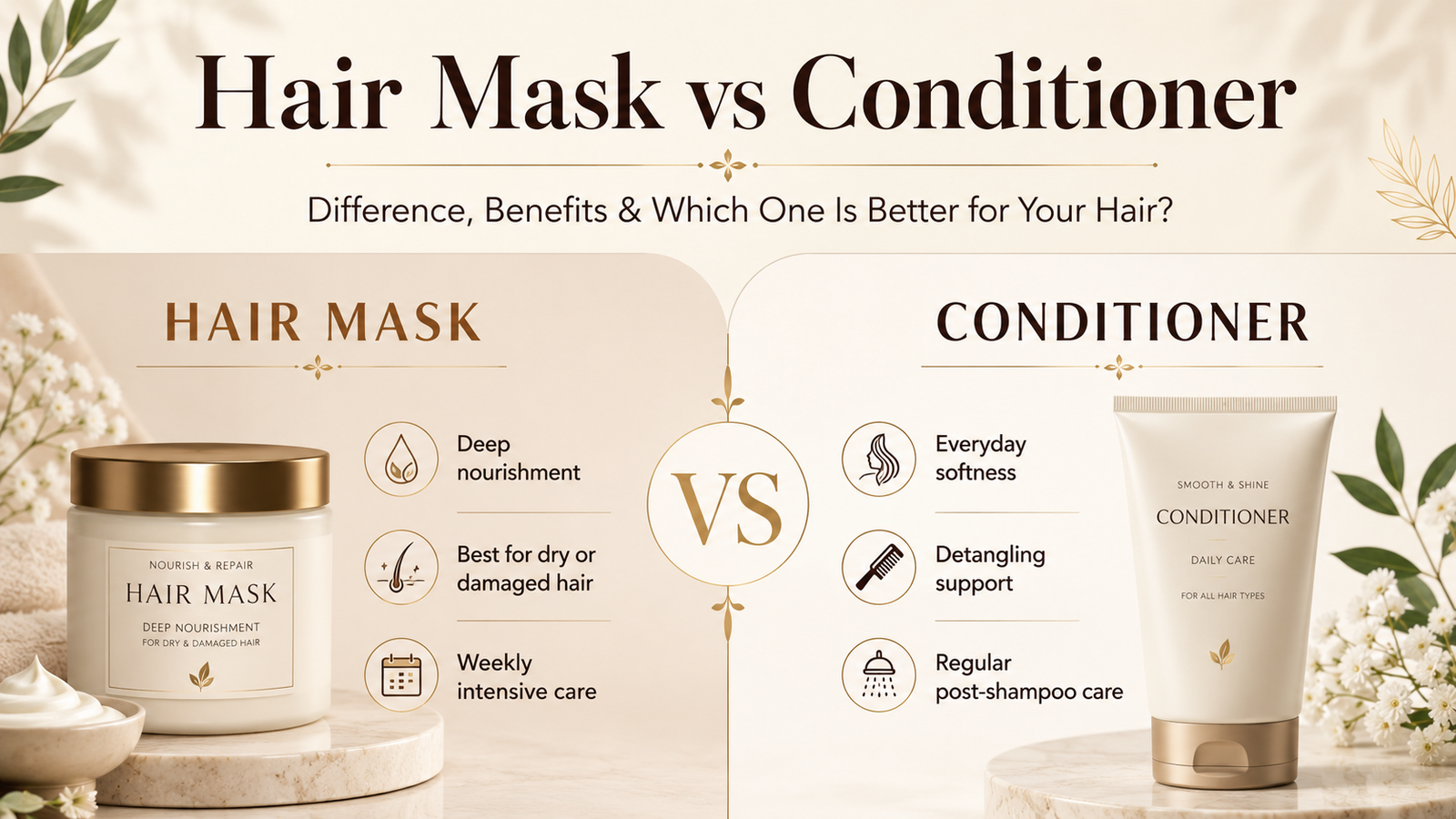

Conditioner and hair mask are not the same. A conditioner is mainly used for regular softness, detangling, and smoothness after shampoo. A hair mask is a deeper treatment designed to provide more intensive nourishment, hydration, and care for dry, frizzy, rough, or damaged hair.
In simple words:
- Conditioner = regular post-shampoo care
- Hair mask = deeper treatment for extra nourishment
Many people think a hair mask and conditioner do the same job, but that is not fully true. If your hair is mildly dry or just needs basic softness after washing, conditioner may be enough. But if your hair is very dry, frizzy, rough, heat-damaged, chemically treated, or difficult to manage, a hair mask can give more intensive support.
Hair Mask vs Conditioner: Quick Difference
| Point | Conditioner | Hair Mask |
|---|---|---|
| Main purpose | Softens and detangles hair after shampoo | Deeply nourishes and conditions hair |
| Intensity | Lighter | More intensive |
| Best for | Regular hair care | Dry, damaged, frizzy, rough hair |
| Use frequency | Usually after every shampoo | Usually once or twice a week |
| Leave-on time | 1–3 minutes | Longer than conditioner |
| Hair feel | Softer and smoother | More deeply nourished and manageable |
| Ideal use | Daily or regular routine | Weekly repair and hydration support |
The easiest way to understand it is:
Conditioner is for maintenance, hair mask is for deeper treatment.
What Is a Conditioner?
A conditioner is a hair care product used after shampoo to soften hair, reduce tangles, improve smoothness, and make hair easier to manage.
Shampoo mainly cleans the scalp and hair by removing dirt, oil, sweat, and buildup. Conditioner helps restore softness after cleansing and reduces that rough post-wash feel.
Conditioner is mostly applied on:
- mid-lengths
- ends
- dry areas of hair
- frizzy sections
For oily scalp users, conditioner is usually not applied heavily on the scalp.
What Does a Conditioner Do?
A conditioner mainly helps with:
- softness
- detangling
- smoother feel
- less roughness
- easier combing
- better manageability
- less frizz after shampoo
It is useful in a regular wash routine and is enough for many people whose hair is not severely dry or damaged.
However, if your hair still feels dry, frizzy, puffy, or rough even after using conditioner, your hair may need deeper care.
What Is a Hair Mask?
A hair mask is a more intensive conditioning treatment than a regular conditioner. It is designed to deeply nourish, hydrate, smooth, and support hair that needs extra care.
Hair masks are often used for:
- dry hair
- frizzy hair
- rough hair
- damaged hair
- chemically treated hair
- coloured hair
- heat-styled hair
- dull hair
- split-end prone hair
A hair mask is usually thicker and richer than a conditioner.
What Does a Hair Mask Do?
A hair mask helps provide deeper support than regular conditioner.
Its main benefits may include:
- deeper nourishment
- more hydration
- smoother feel
- improved softness
- better frizz control
- support for rough and damaged hair
- healthier-looking texture
- more manageable hair
A hair mask is especially useful when the hair needs more than just basic post-shampoo softness.
Hair Mask vs Conditioner: Main Differences
1. Texture and Intensity
Conditioner is usually lighter and made for regular use.
Hair mask is thicker, richer, and more intensive.
This is why a hair mask is generally used less often than conditioner.
2. Purpose
Conditioner is mainly for regular softness and detangling after shampoo.
Hair mask is for deeper conditioning and extra nourishment, especially when hair feels dry, rough, damaged, or weak.
3. How Often to Use
Conditioner is commonly used after every shampoo.
Hair mask is usually used once or twice a week, depending on hair dryness and damage level.
4. How Long to Leave On
Conditioner is usually left on for a short time, often 1–3 minutes.
Hair mask is usually left longer so it can provide deeper conditioning support. Always follow the product label.
5. Best Hair Type for Each
Conditioner is better for:
- normal hair
- regular use
- basic softness
- detangling
- light frizz control
Hair mask is better for:
- dry hair
- frizzy hair
- rough hair
- damaged hair
- coloured or chemically treated hair
- hair that still feels dry after conditioner
Do You Need a Hair Mask If You Already Use Conditioner?
Not everyone needs a hair mask all the time, but many people do benefit from one.
You may need a hair mask if:
- your hair feels dry even after conditioner
- your hair gets frizzy quickly
- your hair is rough after washing
- your hair tangles a lot
- your hair is dull and lifeless
- your hair has been coloured or chemically treated
- you use heat styling often
- your ends feel very dry
So yes, you may still need a hair mask even if you already use conditioner, especially if your hair needs deeper nourishment.
Which Is Better for Dry and Frizzy Hair?
For mild dryness, conditioner may be enough.
But for very dry and frizzy hair, a hair mask is usually the better option because it offers deeper hydration and nourishment.
Dry and frizzy hair is common in India because of:
- humidity
- pollution
- hard water
- sun exposure
- heat styling
- colouring
- harsh shampoos
- frequent washing
In such cases, using only conditioner may not be enough. A hair mask can help improve the feel of the hair more effectively.
Which Is Better for Damaged Hair?
For damaged hair, a hair mask is generally better than conditioner.
Conditioner helps with softness and manageability, but a hair mask is more suitable when the hair is:
- heat-damaged
- chemically treated
- rough
- brittle
- dull
- split-end prone
A hair mask cannot magically reverse severe damage overnight, but it can support smoother-feeling, softer, and healthier-looking hair over time.
Can You Use Both Hair Mask and Conditioner?
Yes, both can be used in a hair care routine — but usually not in the exact same way every wash.
A simple routine can be:
- use conditioner in your regular wash routine
- use hair mask once or twice a week for deeper care
Some people skip conditioner on the day they use a hair mask, while others use both depending on product instructions and hair condition.
The safest approach is to follow the label directions of your chosen products.
How to Use Hair Mask and Conditioner Correctly
A simple routine can look like this:
Regular Wash Day
- Shampoo your hair
- Apply conditioner on mid-lengths and ends
- Leave for a short time
- Rinse well
Deep Care Day
- Shampoo your hair
- Apply hair mask on damp hair
- Focus on mid-lengths and ends
- Leave for the recommended time
- Rinse thoroughly
Avoid using too much product. More product does not always mean better results.
When Should You Choose a Hair Mask?
Choose a hair mask if your hair is:
- very dry
- frizzy
- rough
- dull
- difficult to manage
- chemically treated
- heat-styled often
- lacking softness after conditioner
If your hair feels fine with a regular shampoo and conditioner routine, a hair mask may be optional rather than essential.
When Should You Choose a Conditioner?
Choose conditioner if your goal is:
- regular post-shampoo softness
- detangling
- smoother hair feel
- daily or frequent maintenance
- basic frizz reduction
- easier combing after wash
Conditioner is the more routine-friendly product. Hair mask is the more intensive treatment.
Where Trichospire Deep Conditioning Hair Mask Fits
If your hair needs deeper care than a regular conditioner can provide, Trichospire Deep Conditioning Hair Mask fits naturally into that role.
It may be useful for people with:
- dry hair
- frizzy hair
- rough hair
- damaged hair
- chemically treated hair
- dull and unmanageable hair
Trichospire is positioned as a deep conditioning hair mask for hair that needs nourishment, hydration, softness, and manageability support.
Hair Mask vs Conditioner: Which One Is Better?
The answer depends on your hair.
Conditioner is better if:
- your hair only needs regular softness
- you want a simple everyday routine
- your hair is not very dry or damaged
Hair mask is better if:
- your hair is dry, frizzy, or rough
- your hair is damaged or chemically treated
- your conditioner is not enough
- you want deeper nourishment
So the real answer is:
Conditioner is not better than hair mask, and hair mask is not automatically better than conditioner.
They serve different purposes.
Final Thoughts
Hair mask and conditioner are both useful, but they are not the same.
Conditioner is for regular softness and detangling after shampoo. Hair mask is for deeper nourishment and more intensive care.
If your hair only needs light maintenance, conditioner may be enough. But if your hair is dry, frizzy, rough, damaged, or still feels unhealthy after conditioner, a hair mask can be the better choice.
For users who need a deeper conditioning treatment, Trichospire Deep Conditioning Hair Mask can be a useful addition to the hair care routine.
FAQs-
Q1. What is the main difference between a hair mask and a conditioner?
A conditioner is used for regular softness and detangling after shampoo, while a hair mask is a deeper treatment for extra nourishment, hydration, and care.
Q2. Is hair mask better than conditioner?
Not always. Hair mask is better for dry, frizzy, rough, or damaged hair. Conditioner is better for regular everyday softness and maintenance.
Q3. Can I use a hair mask instead of conditioner?
Sometimes yes, depending on the product and your hair type. But in most routines, conditioner is for regular care and hair mask is for deeper weekly treatment.
Q4. Do I need a hair mask if I already use conditioner?
Ans: You may still need a hair mask if your hair is very dry, frizzy, rough, or damaged, or if conditioner alone is not enough.
Q5. How often should I use a hair mask?
Ans: Usually once or twice a week, depending on your hair type and the product instructions.
Q6. Is conditioner enough for frizzy hair?
Ans: For mild frizz, conditioner may help. For stronger frizz, dryness, or roughness, a hair mask may work better.
Q7. Which is better for damaged hair: hair mask or conditioner?
Ans: Hair mask is usually better for damaged hair because it offers more intensive conditioning support.
Q8. Which hair mask can I try for dry and frizzy hair?
Ans: If you are looking for a deeper conditioning option, Trichospire Deep Conditioning Hair Mask is one option for dry, frizzy, rough, and damaged hair.
Leave a Reply