

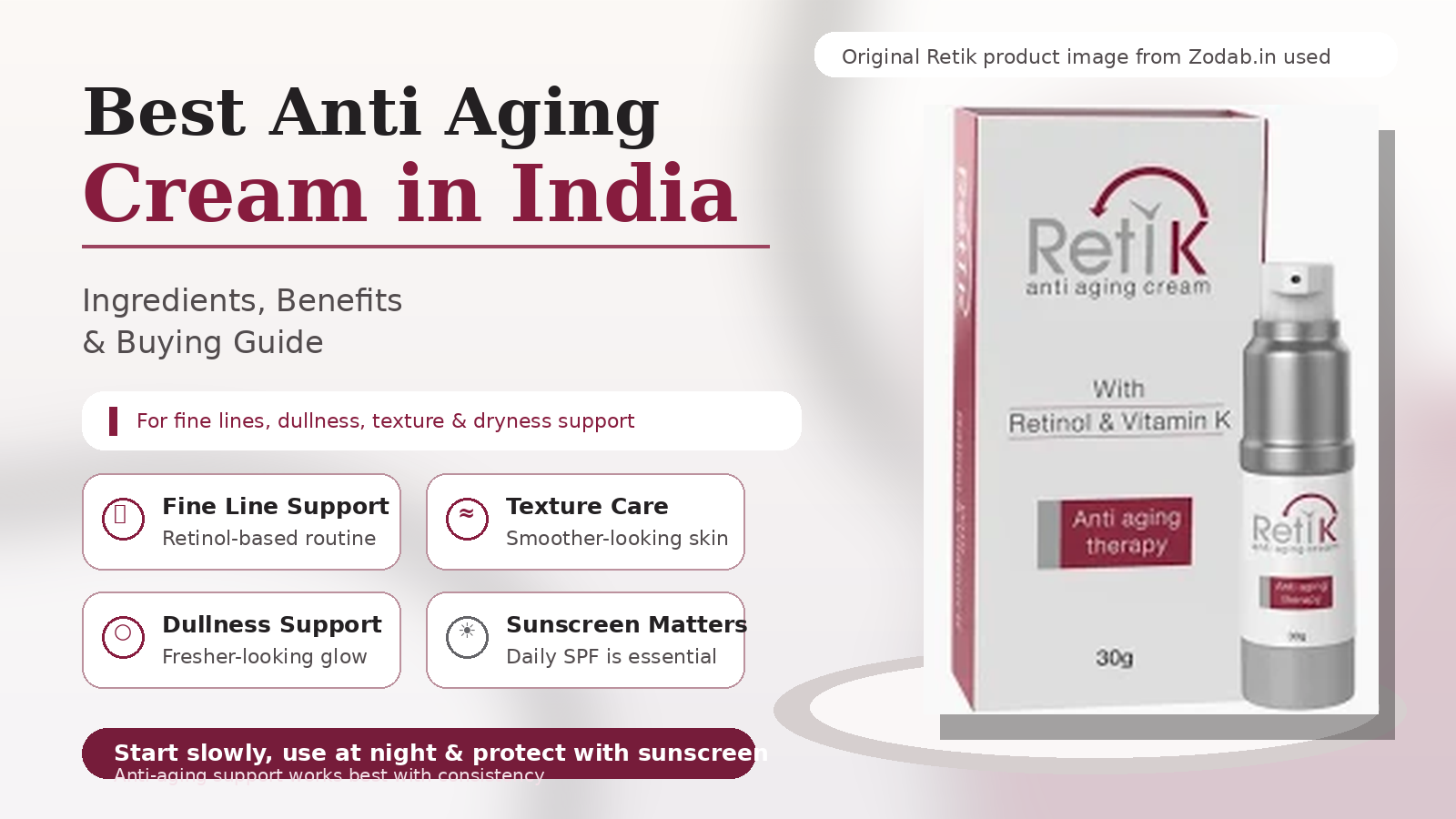

The best anti aging cream in India should support fine lines, dullness, uneven texture, dryness, early wrinkles, and sun-damage-related ageing signs without making unrealistic promises. Anti-aging skincare is not about looking “young overnight.” It is about supporting smoother, healthier-looking, better-hydrated skin over time.
In India, skin ageing can appear earlier because of:
- Sun exposure
- Pollution
- Dehydration
- Dryness
- Stress
- Poor sleep
- Repeated tanning
- Skipping sunscreen
- Harsh skincare habits
- Natural collagen slowdown with age
A good anti-aging cream can help support skin texture, firmness, hydration, and uneven tone. But the real results depend on the ingredients, your skin type, how consistently you use it, and whether you protect your skin from the sun.
If you are looking for an anti-aging cream with ingredients like retinol, Vitamin K1, Vitamin C, and Vitamin E, Retik Anti Aging Cream 30g can be a relevant option to consider. Product listings describe Reti K / Retik cream as a formulation enriched with retinol, Vitamin K1, Vitamin C, and Vitamin E for visible skin rejuvenation and ageing-skin support.
What Does an Anti Aging Cream Actually Do?
An anti-aging cream is designed to support visible signs of ageing such as:
- Fine lines
- Early wrinkles
- Dryness
- Dullness
- Uneven texture
- Rough skin
- Age spots
- Loss of firmness
- Sun-damage-related uneven tone
But no cream can completely stop ageing. Skin ageing is natural. The right product can only help reduce the visible appearance of ageing signs and support healthier-looking skin.
The American Academy of Dermatology notes that retinoid or retinol products can be suitable for mild fine lines, wrinkles, mild pigmentation irregularities, and texture concerns.
Why Skin Starts Showing Ageing Signs
1. Sun Damage
Sun exposure is one of the biggest reasons skin starts looking older, duller, and more uneven. It can contribute to fine lines, pigmentation, tanning, rough texture, and loss of firmness.
This is why sunscreen is the most important anti-aging product in any routine. Mayo Clinic also highlights sun protection as one of the most reliable ways to care for ageing skin and recommends broad-spectrum SPF 30 or higher.
2. Fine Lines and Early Wrinkles
Fine lines can appear around the eyes, forehead, mouth, and smile lines. They may become more visible because of dryness, sun exposure, facial expressions, and collagen slowdown.
Ingredients like retinol can support skin renewal and improve the look of fine lines over time.
3. Dullness
Dull skin often happens when dead skin cells, pollution, oil, and dryness make the face look tired or flat. Ageing skin may also renew more slowly, which can make dullness more noticeable.
4. Uneven Texture
Roughness, tiny bumps, uneven surface, and lack of smoothness can make skin look older. A good anti-aging routine should support smoother-looking texture without irritating the skin barrier.
5. Dryness and Dehydration
Dryness can make fine lines look more visible. Hydrating ingredients and moisturising support can help skin look plumper, softer, and healthier.
6. Pollution and Lifestyle Stress
Pollution, lack of sleep, stress, smoking, and poor routine can make skin look tired and dull. A cream can support the skin, but lifestyle and sunscreen matter too.
What to Look for in the Best Anti Aging Cream in India
A good anti-aging cream should not only say “anti-aging” on the pack. Look for ingredients and routine suitability.
| What to Look For | Why It Matters |
|---|---|
| Retinol or retinoid support | Helps support fine lines, texture, and skin renewal |
| Antioxidants | Help support skin against environmental stress |
| Hydrating ingredients | Reduce dryness and improve skin comfort |
| Brightening-support ingredients | Help with dullness and uneven-looking tone |
| Skin barrier support | Helps reduce irritation and dryness |
| Night-use suitability | Many anti-aging actives are better used at night |
| Clear precautions | Important for sensitive skin and retinol beginners |
The best anti-aging cream is not necessarily the strongest one. It is the one your skin can tolerate consistently.
Best Ingredients in an Anti Aging Cream
1. Retinol
Retinol is one of the most searched and trusted ingredients in anti-aging skincare. It supports skin cell turnover and collagen-related skin renewal, which can help improve the appearance of fine lines, uneven texture, dullness, and ageing-related skin changes.
The American Academy of Dermatology says retinoids can be useful for mild pigmentation irregularities, mild fine lines, and wrinkles, and recommends starting slowly rather than using an intense formula immediately.
Retinol can be helpful, but it can also cause dryness, peeling, redness, or irritation if overused. Beginners should start slowly.
2. Vitamin C
Vitamin C is an antioxidant used in skincare for dullness, uneven tone, and brightening-support routines. It can help support a healthier-looking glow and may complement anti-aging skincare.
Retik / Reti K product listings mention Vitamin C as one of the key ingredients.
3. Vitamin E
Vitamin E is commonly used for antioxidant and skin-conditioning support. It can help improve the feel of skin and support comfort in moisturising formulas.
Retik / Reti K listings mention Vitamin E among the ingredients.
4. Vitamin K1
Vitamin K1 is used in some skincare formulas for skin appearance and tone-support positioning. Retik / Reti K product listings mention Vitamin K1 along with retinol and Vitamin C in the anti-aging formula.
5. Glycerin
Glycerin is a humectant that helps attract and hold moisture in the skin. This can be useful because dry skin can make fine lines look more obvious.
Some Retik / Reti K product listings mention glycerin as part of the cream formula.
6. Moisturising and Barrier-Support Ingredients
Anti-aging creams should not only focus on actives. They should also help maintain skin comfort. If a cream contains retinol, moisturising support becomes even more important because dryness and peeling can happen during early use.
Best Anti Aging Cream in India: Where Retik Anti Aging Cream Fits
If you are looking for an anti-aging cream in India with retinol-based support, Retik Anti Aging Cream 30g fits naturally into this category.
It may be useful for people looking for support with:
- Fine lines
- Early wrinkles
- Dullness
- Uneven texture
- Rough skin
- Age spots
- Sun-damage-related ageing appearance
- Skin renewal support
- Night-time anti-aging routine
Retik / Reti K product listings describe the cream as enriched with retinol, Vitamin K1, Vitamin C, and Vitamin E, and positioned for visible skin rejuvenation and ageing-skin support.
Benefits of Retik Anti Aging Cream
| Benefit | How It May Help |
|---|---|
| Fine line support | Retinol may help improve visible fine lines over time |
| Texture support | Supports smoother-looking skin |
| Dullness support | Vitamin C and retinol may support fresher-looking skin |
| Uneven tone support | Helps support ageing-related uneven appearance |
| Hydration support | Ingredients like glycerin may support moisture comfort |
| Antioxidant support | Vitamin C and Vitamin E support skin against environmental stress |
| Night routine fit | Retinol-based creams are generally better used at night |
Retik Anti Aging Cream should be understood as a skincare-support cream, not a guaranteed wrinkle-removal treatment.
What Retik Anti Aging Cream Can and Cannot Do
| It May Support | It Cannot Guarantee |
|---|---|
| Smoother-looking skin | Complete wrinkle removal |
| Fine line appearance | Instant anti-aging result |
| Dullness support | Permanent reversal of ageing |
| Uneven texture | Deep wrinkle correction |
| Skin renewal routine | Replacing sunscreen |
| Hydration support | Treating medical skin conditions |
| Ageing-skin care | Same results for every skin type |
This honest positioning is important because overpromising anti-aging results can reduce trust.
How to Use an Anti Aging Cream Correctly
If your anti-aging cream contains retinol, use it carefully.
A simple night routine can look like this:
- Cleanse your face gently.
- Pat the skin dry completely.
- Apply a small amount of anti-aging cream.
- Avoid the eye corners, lips, and irritated areas unless the product says otherwise.
- Follow with moisturiser if your skin feels dry.
- Use sunscreen every morning.
Retik / Reti K product listings commonly suggest using it at night and applying sunscreen during the day.
How Often Should You Use an Anti Aging Cream?
If you are new to retinol, do not start with daily use immediately.
A safer beginner approach:
| Skin Tolerance | Suggested Frequency |
|---|---|
| Beginner | 2–3 nights a week |
| Normal tolerance | Alternate nights |
| Well-adjusted skin | Nightly if tolerated |
| Sensitive skin | Start slowly or ask dermatologist |
| Dry or peeling skin | Reduce frequency |
| Irritated skin | Stop until skin recovers |
The AAD recommends starting with the least-intense retinoid formula and using it every other night at first, then slowly building up.
Why Sunscreen Is Essential With Anti Aging Cream
If you use anti-aging cream but skip sunscreen, results may remain limited.
Sunscreen helps protect against:
- Sun damage
- Tanning
- Dark spots
- Uneven tone
- Fine lines
- Premature ageing
- Retinol-related sun sensitivity
Mayo Clinic advises using broad-spectrum sunscreen with SPF 30 or higher and reapplying every two hours, or more often after swimming or sweating.
So, anti-aging cream at night and sunscreen in the morning is a smarter routine than using anti-aging cream alone.
Who Should Use an Anti Aging Cream?
An anti-aging cream may be useful if you are dealing with:
- Early fine lines
- Dull skin
- Uneven texture
- Roughness
- Dryness-related ageing appearance
- Sun-damage-related uneven tone
- Age spots
- Loss of glow
- Mature skin concerns
People in their late 20s, 30s, 40s, and above may consider anti-aging skincare depending on their skin condition and goals.
Who Should Be Careful?
Be careful with retinol-based anti-aging creams if you have:
- Very sensitive skin
- Active irritation
- Peeling skin
- Broken skin
- Eczema-prone skin
- Rosacea-prone skin
- Severe acne treatment routine
- Recent peel or laser treatment
- Pregnancy or breastfeeding
- Skin already using strong actives
If you are pregnant, breastfeeding, using prescription acne treatments, or dealing with a skin condition, consult a dermatologist before using retinol-based creams.
Common Mistakes to Avoid
1. Expecting Overnight Results
Anti-aging creams need time. Fine lines, texture, and dullness usually improve gradually.
2. Using Too Much Product
More cream does not mean faster results. Too much retinol can irritate the skin.
3. Skipping Sunscreen
This is the biggest mistake. Sun damage can undo your anti-aging routine.
4. Mixing Too Many Actives
Avoid layering retinol with multiple strong actives like exfoliating acids, benzoyl peroxide, or harsh peels unless advised.
5. Using Retinol on Irritated Skin
Do not apply retinol-based cream on peeling, burning, or irritated skin.
6. Ignoring Moisturiser
Moisturiser helps reduce dryness and supports skin barrier comfort.
Best Anti Aging Routine for Beginners
A simple routine works better than an overloaded routine.
Morning Routine
- Gentle cleanser
- Moisturiser
- Broad-spectrum SPF 30+ sunscreen
Night Routine
- Gentle cleanser
- Retik Anti Aging Cream or your chosen anti-aging cream
- Moisturiser if needed
Start slowly, observe your skin, and increase frequency only if your skin is comfortable.
Final Thoughts
The best anti aging cream in India should support fine lines, dullness, uneven texture, dryness, and ageing-related skin changes without making unrealistic promises. Look for ingredients like retinol, Vitamin C, Vitamin E, Vitamin K1, glycerin, and moisturising support.
For users looking for a retinol-based option, Retik Anti Aging Cream 30g can be a relevant product to consider. It fits best into a night-time skincare routine and should be paired with daily sunscreen for better ageing-skin support.
Use it patiently, start slowly, moisturise well, and protect your skin from the sun every morning.
FAQs-
Q1. Which is the best anti aging cream in India?
Ans: The best anti aging cream depends on your skin type and concerns. Look for ingredients like retinol, Vitamin C, Vitamin E, moisturising ingredients, and sunscreen support. Retik Anti Aging Cream 30g is one retinol-based option for ageing-skin support.
Q2. Is Retik Anti Aging Cream good for fine lines?
Ans: Retik Anti Aging Cream contains retinol, which is commonly used for fine lines, texture, and skin renewal support. Results depend on consistency, skin tolerance, and sunscreen use.
Q3. Can anti-aging cream remove wrinkles?
Ans: Anti-aging creams may reduce the appearance of fine lines and improve skin texture, but they cannot completely remove deep wrinkles or stop ageing.
Q4. What age should I start using anti-aging cream?
Ans: Many people start anti-aging skincare in their late 20s or 30s, depending on their skin condition, sun exposure, and goals. Sunscreen can be started much earlier as a daily habit.
Q5. Can I use anti-aging cream daily?
Ans: Some people can use it daily after their skin adjusts, but beginners should start slowly, especially with retinol-based creams.
Q6. Should anti-aging cream be used at night?
Ans: Retinol-based anti-aging creams are generally better used at night. Sunscreen should be used in the morning.
Q7. Is sunscreen necessary with anti-aging cream?
Ans: Yes. Sunscreen is essential. Without sunscreen, sun damage can worsen fine lines, pigmentation, tanning, and uneven tone.
Q8. Where can I buy Retik Anti Aging Cream online?
Ans: You can buy Retik Anti Aging Cream 30g from Zodab.in through the product page:
The best anti aging cream depends on your skin type and concerns. Look for ingredients like retinol, Vitamin C, Vitamin E, moisturising ingredients, and sunscreen support. Retik Anti Aging Cream 30g is one retinol-based option for ageing-skin support.
Leave a Reply